2026Case study
CompletedElectrum Dependency Analysis Framework
A full-stack dependency analysis framework that maps Maven graphs, classifies release breakage, and opens version-bump pull requests in dependency order.
The problem
In a large Maven ecosystem, one library release can ripple through dozens of artifacts. Semantic versioning is a promise, not a proof: even a patch release can break a downstream build or a test without anyone noticing until the next upgrade. Electrum wanted to know what a release affects, what can be updated automatically, and what needs a developer.
The project ran across three Agile sprints with Electrum engineers, in a team of six. I was the Scrum Master and worked primarily on the backend and analysis pipeline.
What I built
I worked on the services and analysis path behind the product: scenario loading and graph caching, the breakage analysis pipeline, the REST API, and the report generation that turns build evidence into a verdict. That included the Surefire evidence parser, the semantic-versioning honesty audit, the API surface comparison and the JSON report model.
I also worked on the propagation side: generating the GitHub Packages Maven configuration and least-privilege CI/release workflows, and applying the minimal version-bump edits that let a dependent repository open a reviewable pull request.
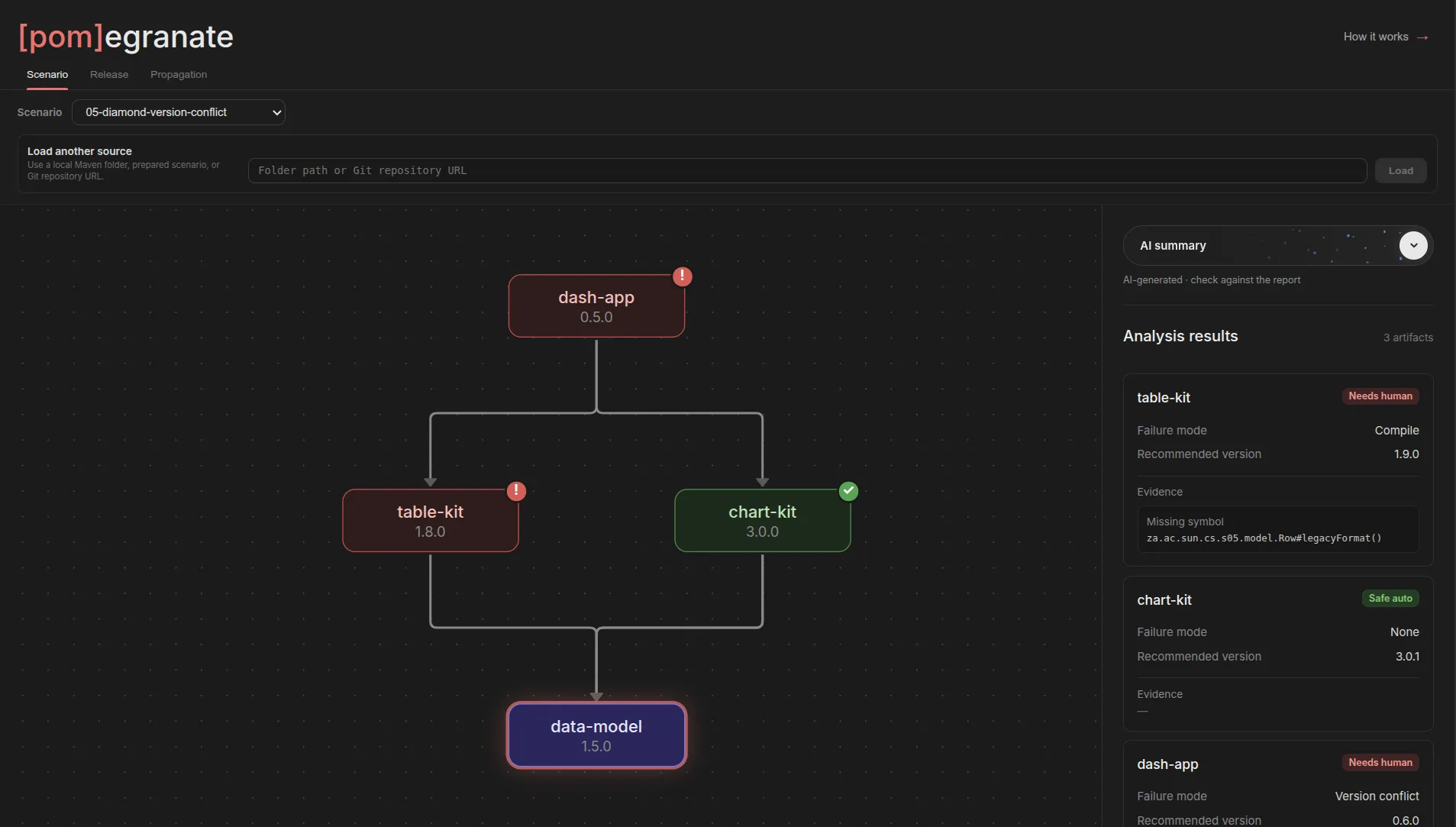
The React and React Flow interface was built by teammates; the screenshot above is the application those services power.
The hard part
The product’s core claim is a verdict you can trust. A rebuild alone can lie: a dependency can appear to work because a stale binary is still on the classpath, while an inlined constant or return-type change slips through. Semantic versioning alone can lie too: a patch release can still change behaviour in a way that breaks a consumer’s tests.
The team built a build-and-see oracle, then added a stale-binary probe, a bytecode API diff and a usage scan to separate real breakage from false alarms. The final report distinguishes NOT_AFFECTED, SAFE_AUTO and NEEDS_HUMAN, with evidence attached.
Propagation was the other hard part. Updating a graph in memory is not the same as updating a real ecosystem: releases have to be published in dependency order, pull requests have to open only after their dependencies are available, and a red CI run has to block the next wave.
Decisions
- Real Maven resolution, not XML parsing. The team ran
mvn dependency:treeso property interpolation, scopes and transitive resolution matched what Maven actually does. - Evidence, not a single oracle. Rebuilds, stale-binary probes, bytecode diffs and semver honesty checks all feed the same report instead of pretending one signal is enough.
- A schema-validated report. The UI, the pull requests and the tests all consume the same contract, which made the pipeline testable against a known answer key.
- Human merge, always. The tool opens pull requests and labels them
safe-autoorneeds-human; it never merges on its own.
Outcome
The project matched all 15 seeded, CI-verified breakage cases. The repository carries 270+ backend tests, a React Flow graph UI, Docker packaging and a GitLab CI pipeline. The team also ran the analysis against real open-source projects, including Jackson, commons-configuration, commons-lang3 and OpenFeign.
The final demo showed the full loop: load a real Maven graph, run an analysis, export repositories, publish baselines, open pull requests in dependency order, and let a human merge.
What I’d do differently
I would invest even earlier in the stale-binary probe and the semver honesty audit. They were the difference between a convincing demo and a verdict an engineer could actually trust.
Next project