2025Case study
CompletedWISTL Compiler
A compiler for WISTL, a small LL(1) teaching language, from scanner and parser to type checking and JVM class-file generation.
The problem
WISTL is a small imperative teaching language with a proper grammar, types, arrays, functions and procedures. The project was to write a compiler for it in C: read a source file, check it, and produce something the JVM can actually run. The interesting part is not a single stage; it is making the whole pipeline agree on what a program means.
What I built
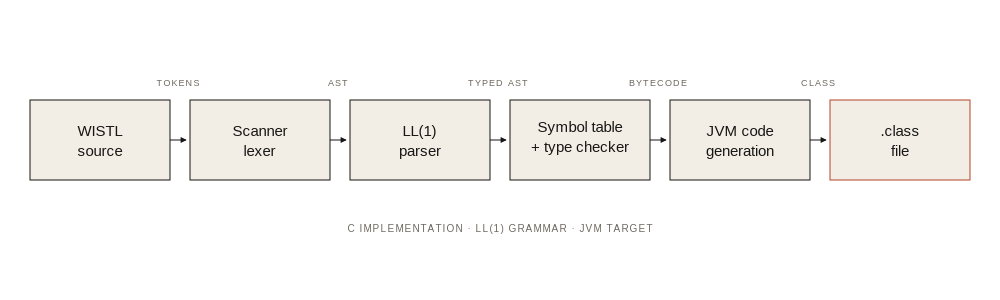
The compiler covers the full pipeline: a scanner that turns source into tokens, an LL(1) recursive-descent parser that builds the syntax tree, a hash-table symbol table, a type checker that validates expressions, statements, arrays and function or procedure calls, and a code generator that emits JVM class files.
The project also has a command-line compiler entry point, structured error reporting and the supporting build and test scaffolding needed to work through the compiler in stages.
The hard part
Type checking is where a compiler stops being a parser. The checker has to distinguish scalars from arrays, functions from procedures, and a call with too few arguments from a call with too many. It has to catch unknown identifiers and duplicate definitions, and it has to do all of that while keeping the error messages useful enough that a student can fix the program.
The code generator has its own set of constraints: a JVM class file has a constant pool, bytecode offsets and a stack model, and the compiler has to keep them consistent while generating code for expressions, control flow and calls. Writing that in C adds the usual memory-management discipline.
Decisions
- C, not a managed language. The project was deliberately close to the metal: manual allocation, explicit data structures and no runtime safety net.
- LL(1) recursive descent. The grammar is designed for it, and a hand-written parser makes the error messages and the type-checking hooks easier to control.
- A hash-table symbol table. Scope and lookup are central to the type checker, so the symbol table is a real data structure rather than a linear list.
- JVM class files as the target. The output is executable, not an interpreter’s internal representation, which forces the code generator to respect a real bytecode format.
- Incremental stages. Scanner, parser, type checker and code generator were built and tested in sequence, so each stage had a stable contract before the next one depended on it.
Outcome
The project delivered a working compiler that scans, parses, type-checks and generates JVM class files for WISTL programs. It was the main project for CS244 and the first time I had to make an entire language pipeline fit together end to end.
What I’d do differently
I would build a golden-file test harness for scanner and parser errors before starting the code generator. Compiler errors are the interface a user sees most often, and it is much easier to keep them consistent when the expected output is part of the test suite from the beginning.
Next project